
First built 1956
Proposed by Dwight D. Eisenhower
Completed 1992*
Cost $114B**
Total length 48,756 mi***
Longest I-90; 3,020 mi
Total highways 70****
State with the most Illinois; 13
Highway with most states I-95; 15
*originally proposed system
**$558B in 2021 dollars
***as of 2020
****primary highways, or those with numbers less than 100
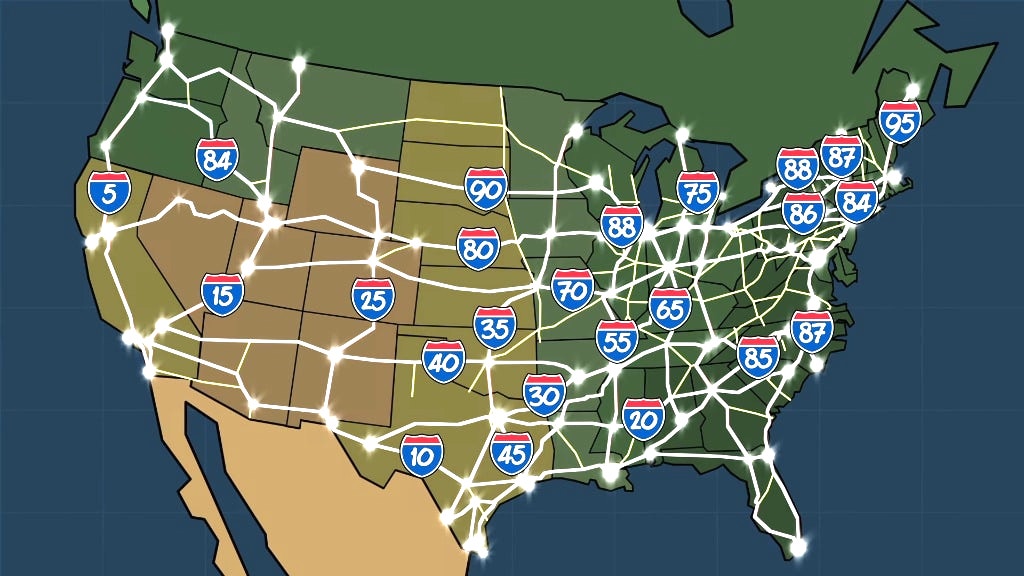
The Dwight D. Eisenhower National System of Interstate and Defense Highways, more commonly known as the Interstate Highway System, connects the contiguous United States via controlled-access freeways. These roads can only be accessed via ramps and interchanges, with no traffic lights, railroad crossings, or other at-grade intersections. It has profoundly impacted American transport, economics, and advancement. For the first time ever, anyone with a motor vehicle could now travel across the country without the constant traffic lights, low speed limits (in small towns), and other annoyances associated with older highways (aka back roads). The freeway system was proposed by Former President Dwight D. Eisenhower in the wake of both the Cold War and a decades-long desire for a nationalized highway network.
Today, the Interstate Highway System comprises 70 primary highways and scores of auxilary highways. Primary highways are the major arteries that form the backbone of the interstate network. For example, I-40 connects Wilmington, NC to Barstow, California. Auxilary highways are smaller freeways that branch off of or loop back to their "parent" primary route. For example, I-140 connects I-40 near Wilmington, NC, to communities and roads not served by I-40.
2-digit, odd
2-digit, even
3-digit, 1st # odd
3-digit, 1st # even
The Interstate Highway System has radically altered the course of American history. Urbanization accelerated while fortunate city dwellers moved to the suburbs, commuting on the interstate. These shifts contributed positively to economic development by accelerating delivery of essential supplies and boosting tourism in certain areas. For example, tourism in my hometown Wilmington, North Carolina, was 50% higher in 2000 than in 1990, when the extension of I-40 to the city was finished.

But the new highways profoundly harmed many communities, particularly those already struggling. Rural towns, for instance, suffered the double whammy of losing residents (to growing cities) and being bypassed by travelers. Mom-and-pop shops that once supported long-distance drivers were superseded by chain fast-food restaurants, nationally-recognized gas stations, and other corporate-owned businesses. (You know how there's a McDonald's, Shell, Burger King, BP, etc. right off every exit?) Urban freeways, meanwhile, have decimated many neighborhoods, the vast majority of which are minority-dominant. Furthermore, the increase in motor vehicle traffic as well as deforestation for the paving of highways has substantially harmed the environment.

Interstate highways symbolize American progress and development but also ongoing inequality and injustice. Most Americans benefited greatly from this highway system. But those who did not benefit faced immense suffering and grief. Highway planners and traffic engineers should focus more on protecting vulnerable communities and re-routing the most disruptive roads. New systems altogether, like high-speed rail, could be developed to slash the harm to the Earth. Overall, the Interstate Highway System has long lists of both positive and negative ramifications, but policymakers can learn lessons to enable them to maximize the positives and minimize the negatives.